
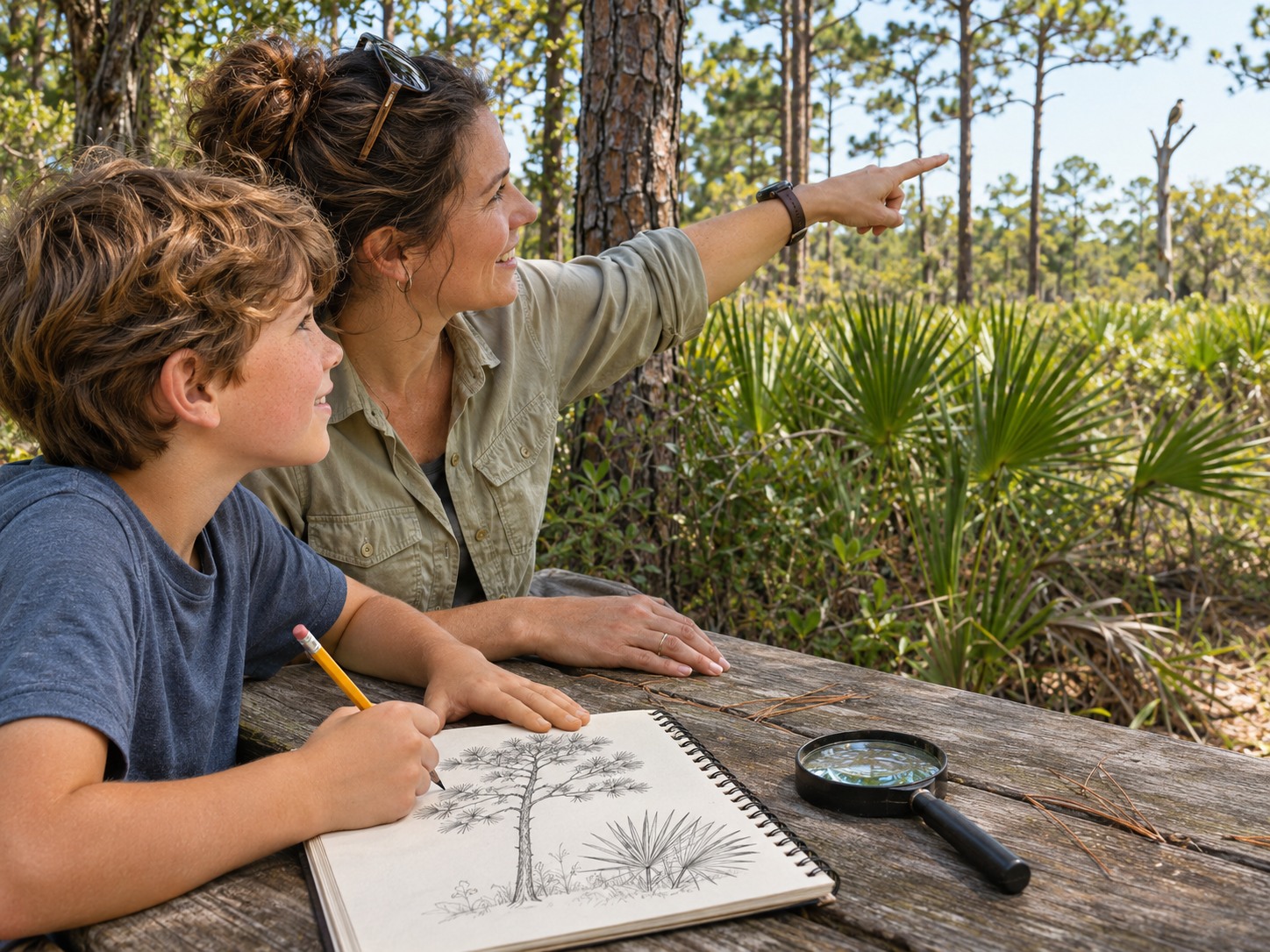
Help your learner notice how a place supports life.
- Science
- Nature study
- Mixed subjects
Florida Habitat Field Lab Mini-Unit
A short Florida science mini-unit turns habitat clues into questions, sketches, comparisons, and a simple model.
- Suggested grades
- Grades 2–8, with flexible K–2 entry ideas
- Format
- Printable PDF · Digital download · Mini-unit
- Subjects
- Science, Nature study, Mixed subjects
- Files
- 8 pages · Ink-friendly printable PDF
- Delivery
- Digital download — no physical item ships
About this resource
A habitat is more than a place on a map. It is a place where living things find resources they need. This eight-page mini-unit helps families explore that idea with a photograph, a nature book, a window view, or a safe outdoor observation. Examples introduce Florida pine flatwoods and freshwater sloughs in Everglades National Park, then invite learners to compare clues and make a simple habitat model.
Children can draw, label, talk, dictate, or write. Adaptations offer younger learners a clear way to begin and older learners a chance to compare evidence and explain a possible connection. The pack emphasizes respectful observation: go with an adult, stay on permitted paths, observe wildlife from a distance, and leave natural objects where they are.
What's included
- 8-page printable PDF mini-unit
- Family guide with safe-observation reminders and grade-band adaptations
- Pine flatwoods and freshwater slough fact snapshots
- Three habitat field-lab pages with sketch and note space
- Habitat needs and connection activity
- Simple habitat-model challenge and learning reflection
- Source notes referencing FWC and National Park Service resources
Learning goals
- Identify living and nonliving habitat clues
- Describe how habitats provide resources such as food, water, shelter, and space
- Compare observations using details from a photo or safe observation place
- Ask questions and distinguish observed evidence from a guess
A good fit for
- Families exploring Florida science and nature
- Learners who enjoy sketching, comparing, and asking questions
- Mixed-age siblings using the same topic at different depths
- A short supplemental unit for home learning or nature study
How to use it
- Choose a habitat photo, nature book, window view, or safe place to observe with an adult.
- Use one field-lab page to notice, sketch, and label a few clues.
- Compare a second habitat or complete the model challenge if it fits your learner.
- Use the reflection page to record what you learned and one question to explore next.
Questions & answers
Do we need to visit a park?
No. You can use a photo, book, window view, or safe outdoor spot. Do not enter a habitat or touch wildlife for this activity.
Which habitats are featured?
The pack introduces Florida pine flatwoods and freshwater sloughs in Everglades National Park, then offers a flexible comparison activity.
Are species identifications required?
No. Careful descriptions of visible clues are useful. The goal is observation and asking questions.
What ages can use the mini-unit?
Suggested for Grades 2–8, with flexible K–2 entry ideas and extensions for older learners.
What are the sources?
Florida Fish and Wildlife Conservation Commission habitat information and National Park Service Everglades habitat and freshwater slough pages are named in the printable.
Pair it with Florida Backyard Nature Detective Pack for more observation practice close to home.